> ## Documentation Index
> Fetch the complete documentation index at: https://docs.flexoworks.com/llms.txt
> Use this file to discover all available pages before exploring further.
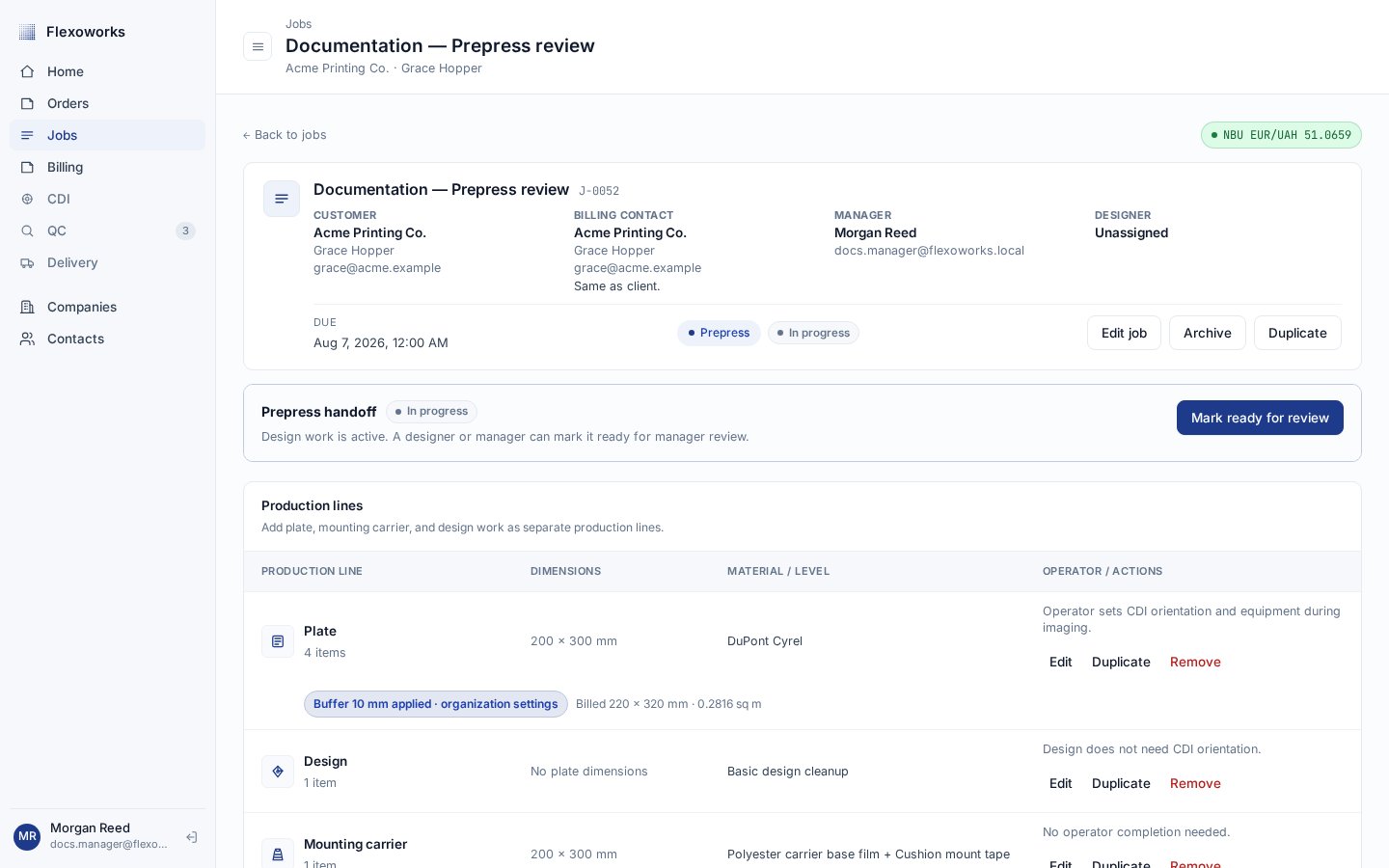
# Production lines: work, quantity, and billing
> Learn when to group or split production work, which fields belong to Plate, Mounting carrier, and Design lines, and how lines drive completion and billing.
A **job** is the container for one piece of production work: its customer,
files, instructions, assignments, stage, and history. **Production lines**
describe what the team will make or prepare inside that job.
[Converting an order creates one or more jobs](/guides/orders-and-jobs) when the
team accepts the requested work for production. Each new job can receive
suggested production lines from the conversion, or a manager can add and
correct them on the job during **Intake** and **Prepress**. The source order
remains available as a converted record.
The UI calls this section **Production lines**, not “plate lines,” because it
contains **Plate**, **Mounting carrier**, and **Design** work. A production
line can represent several identical units of work or physical items through
**Quantity**.
 ## Decide what belongs on one line
Use one line for items that can be treated as one repeatable batch. Put the
number of identical items in **Quantity**.
For example, `4 × Plate · 200 × 300 mm · DuPont Cyrel` belongs on one Plate
line when all four plates will use the same buffer and can be completed with
the same CDI orientation and equipment.
Split the work into separate lines when any of these details differ:
* production-line kind;
* **Width**, **Height**, or dimension unit;
* **Plate material**;
* **Base film** or **Cushion mount**;
* **Design level**;
* Plate **Buffer**;
* expected CDI orientation, equipment, or completion time.
Completion applies to the line's **entire Quantity**. If two plates will be
imaged now and two later, or they need different orientation or equipment,
create two lines with Quantity `2` before the job leaves Prepress.
This distinction keeps production and pricing truthful. Quantity groups
identical work; separate lines preserve meaningful differences.
## Add each kind with the right fields
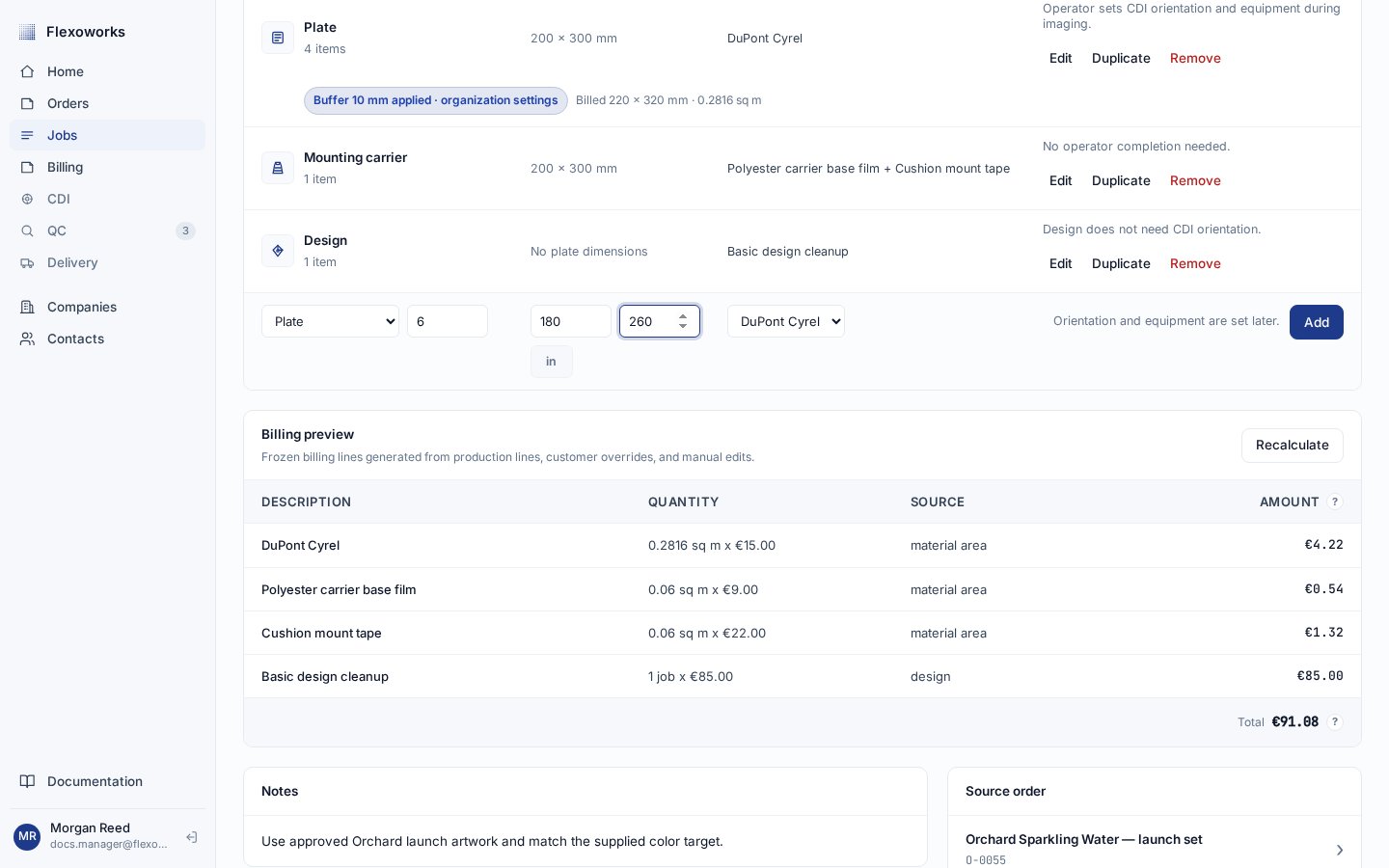
Open an active job in **Intake** or **Prepress**, find **Production lines**, and
use the empty row at the bottom. Choose the kind, enter its fields, and select
**Add**.
## Decide what belongs on one line
Use one line for items that can be treated as one repeatable batch. Put the
number of identical items in **Quantity**.
For example, `4 × Plate · 200 × 300 mm · DuPont Cyrel` belongs on one Plate
line when all four plates will use the same buffer and can be completed with
the same CDI orientation and equipment.
Split the work into separate lines when any of these details differ:
* production-line kind;
* **Width**, **Height**, or dimension unit;
* **Plate material**;
* **Base film** or **Cushion mount**;
* **Design level**;
* Plate **Buffer**;
* expected CDI orientation, equipment, or completion time.
Completion applies to the line's **entire Quantity**. If two plates will be
imaged now and two later, or they need different orientation or equipment,
create two lines with Quantity `2` before the job leaves Prepress.
This distinction keeps production and pricing truthful. Quantity groups
identical work; separate lines preserve meaningful differences.
## Add each kind with the right fields
Open an active job in **Intake** or **Prepress**, find **Production lines**, and
use the empty row at the bottom. Choose the kind, enter its fields, and select
**Add**.
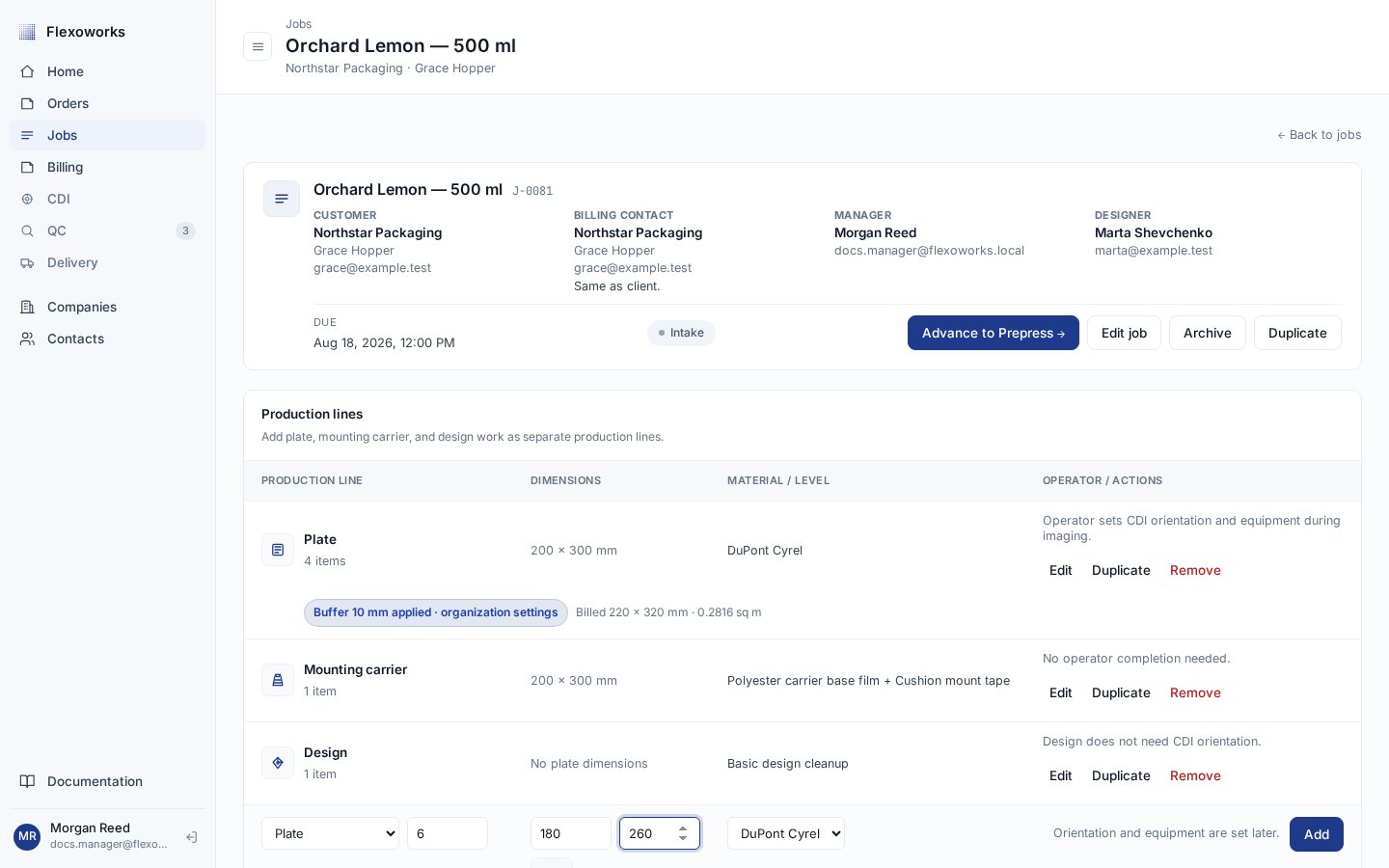 | Kind | Fields in the UI | What the line means |
| -------------------- | ------------------------------------------------------------------------------------------ | ------------------------------------------------------------------------------------------------------------- |
| **Plate** | **Quantity**, **Width**, **Height**, **Plate material**; optional **Buffer** after editing | Photopolymer plates made from one material at one size. CDI orientation and **Equipment** are recorded later. |
| **Mounting carrier** | **Quantity**, **Width**, **Height**, **Base film**, **Cushion mount** | A physical carrier using the selected pair of materials. No operator completion is required. |
| **Design** | **Quantity**, **Design level** | Design work priced from the selected level. It has no physical plate dimensions and needs no CDI orientation. |
For a line added directly on the job, the physical dimension unit appears
beside **Width** and **Height** and follows the organization's configured
dimension unit. Positive dimensions and the required material fields must be
present before **Add** is enabled. A converted line can retain a dimension unit
explicitly supplied by the order.
### Complete dimensions brought in from an order
An order can be converted when a Plate or Mounting carrier size is not yet
known. The resulting job shows **No plate dimensions** for that line. This is a
deliberate unknown value, not a zero-size plate.
During Intake or Prepress, use **Edit** to enter **Width** and **Height**. If an
uploaded PDF exposes its page size, its file card can also offer **Update
production line from PDF**. Check that the PDF size is the actual production
size before applying it.
Missing details appear as warnings in the Prepress handoff. They do not block a
submission for manager review, but the team should resolve them before
approval: a Plate without dimensions or material cannot be completed by an
operator.
### Understand Plate buffer
**Buffer** adds an allowance to every side of a Plate. It affects billed
dimensions and area, but it does not change the raw **Width** and **Height**.
For a 200 × 300 mm Plate with a 10 mm Buffer:
`billed size = (200 + 2 × 10) × (300 + 2 × 10) = 220 × 320 mm`
The billed area is then multiplied by **Quantity**. The buffer applies only to
**Plate** lines, not Mounting carrier or Design lines.
After a line is saved, select **Edit** to set a line-specific **Buffer**. Leave
it inherited to use the selected **Billing company** setting. When there is no
separate billing company, Flexoworks uses the customer company setting, then
falls back to the organization setting. The saved line shows the effective
value and its source—**line override**, **company settings**, or **organization
settings**—as well as the billed size and area.
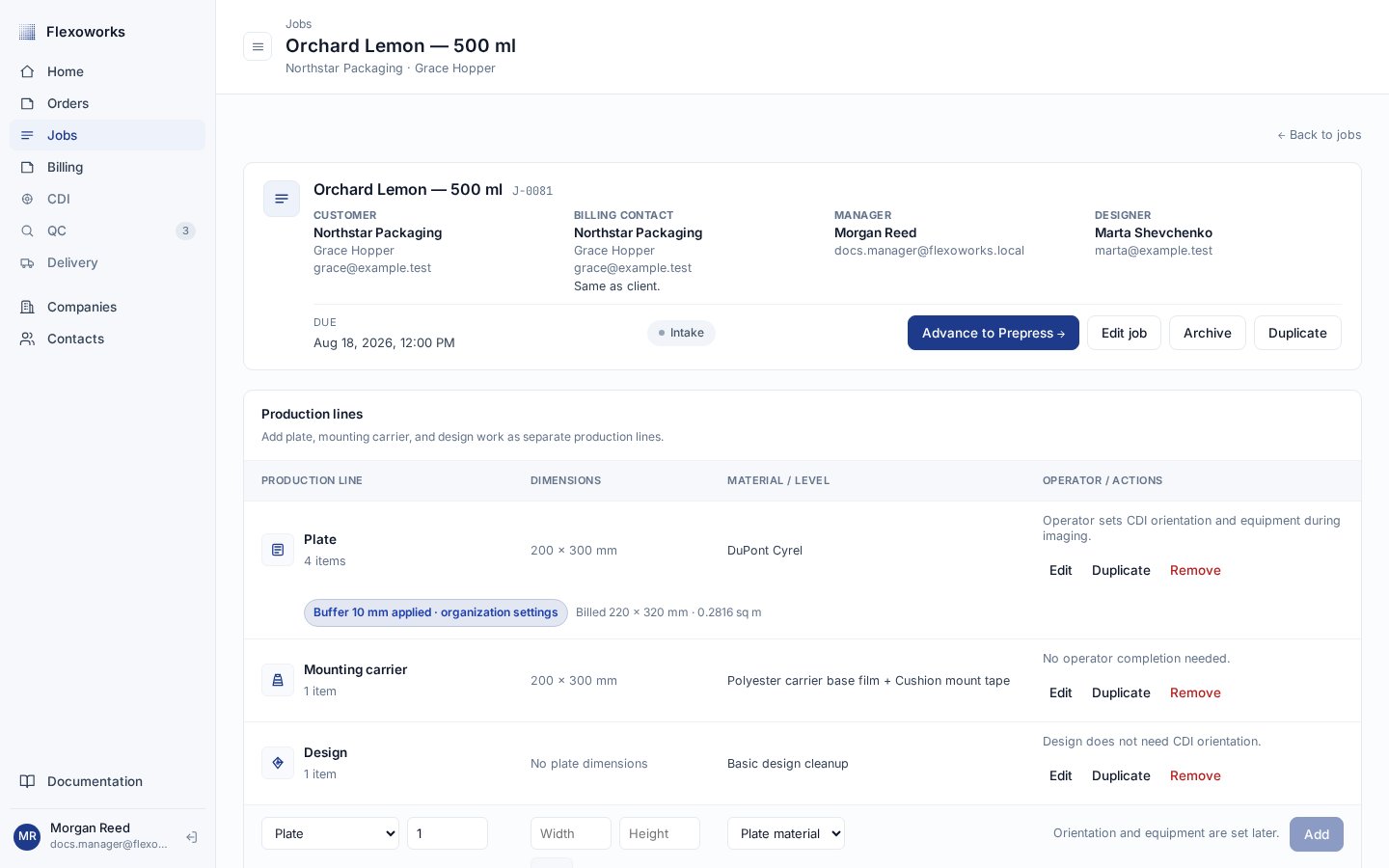
## Edit, duplicate, or remove a line
Every saved line has three early-stage actions:
* **Edit** corrects that line in place.
* **Duplicate** starts a copy, which is useful when most fields are the same but
one meaningful detail differs.
* **Remove** deletes the line from the job.
| Kind | Fields in the UI | What the line means |
| -------------------- | ------------------------------------------------------------------------------------------ | ------------------------------------------------------------------------------------------------------------- |
| **Plate** | **Quantity**, **Width**, **Height**, **Plate material**; optional **Buffer** after editing | Photopolymer plates made from one material at one size. CDI orientation and **Equipment** are recorded later. |
| **Mounting carrier** | **Quantity**, **Width**, **Height**, **Base film**, **Cushion mount** | A physical carrier using the selected pair of materials. No operator completion is required. |
| **Design** | **Quantity**, **Design level** | Design work priced from the selected level. It has no physical plate dimensions and needs no CDI orientation. |
For a line added directly on the job, the physical dimension unit appears
beside **Width** and **Height** and follows the organization's configured
dimension unit. Positive dimensions and the required material fields must be
present before **Add** is enabled. A converted line can retain a dimension unit
explicitly supplied by the order.
### Complete dimensions brought in from an order
An order can be converted when a Plate or Mounting carrier size is not yet
known. The resulting job shows **No plate dimensions** for that line. This is a
deliberate unknown value, not a zero-size plate.
During Intake or Prepress, use **Edit** to enter **Width** and **Height**. If an
uploaded PDF exposes its page size, its file card can also offer **Update
production line from PDF**. Check that the PDF size is the actual production
size before applying it.
Missing details appear as warnings in the Prepress handoff. They do not block a
submission for manager review, but the team should resolve them before
approval: a Plate without dimensions or material cannot be completed by an
operator.
### Understand Plate buffer
**Buffer** adds an allowance to every side of a Plate. It affects billed
dimensions and area, but it does not change the raw **Width** and **Height**.
For a 200 × 300 mm Plate with a 10 mm Buffer:
`billed size = (200 + 2 × 10) × (300 + 2 × 10) = 220 × 320 mm`
The billed area is then multiplied by **Quantity**. The buffer applies only to
**Plate** lines, not Mounting carrier or Design lines.
After a line is saved, select **Edit** to set a line-specific **Buffer**. Leave
it inherited to use the selected **Billing company** setting. When there is no
separate billing company, Flexoworks uses the customer company setting, then
falls back to the organization setting. The saved line shows the effective
value and its source—**line override**, **company settings**, or **organization
settings**—as well as the billed size and area.
## Edit, duplicate, or remove a line
Every saved line has three early-stage actions:
* **Edit** corrects that line in place.
* **Duplicate** starts a copy, which is useful when most fields are the same but
one meaningful detail differs.
* **Remove** deletes the line from the job.
 Creating, editing, or removing a line recalculates the generated rows in
**Billing preview**. Editing production data while a manager review is pending
also reopens the review because its saved production snapshot is no longer
current.
Production lines can be changed only in **Intake** and **Prepress**. Manager
approval moves the job to **Imaging** and locks the line specification. Review
quantities, dimensions, materials, levels, and splits before selecting
**Approve and send to Imaging**. See [Prepress review and manager
handoff](/guides/prepress-review) for the complete approval flow.
Creating, editing, or removing a line recalculates the generated rows in
**Billing preview**. Editing production data while a manager review is pending
also reopens the review because its saved production snapshot is no longer
current.
Production lines can be changed only in **Intake** and **Prepress**. Manager
approval moves the job to **Imaging** and locks the line specification. Review
quantities, dimensions, materials, levels, and splits before selecting
**Approve and send to Imaging**. See [Prepress review and manager
handoff](/guides/prepress-review) for the complete approval flow.
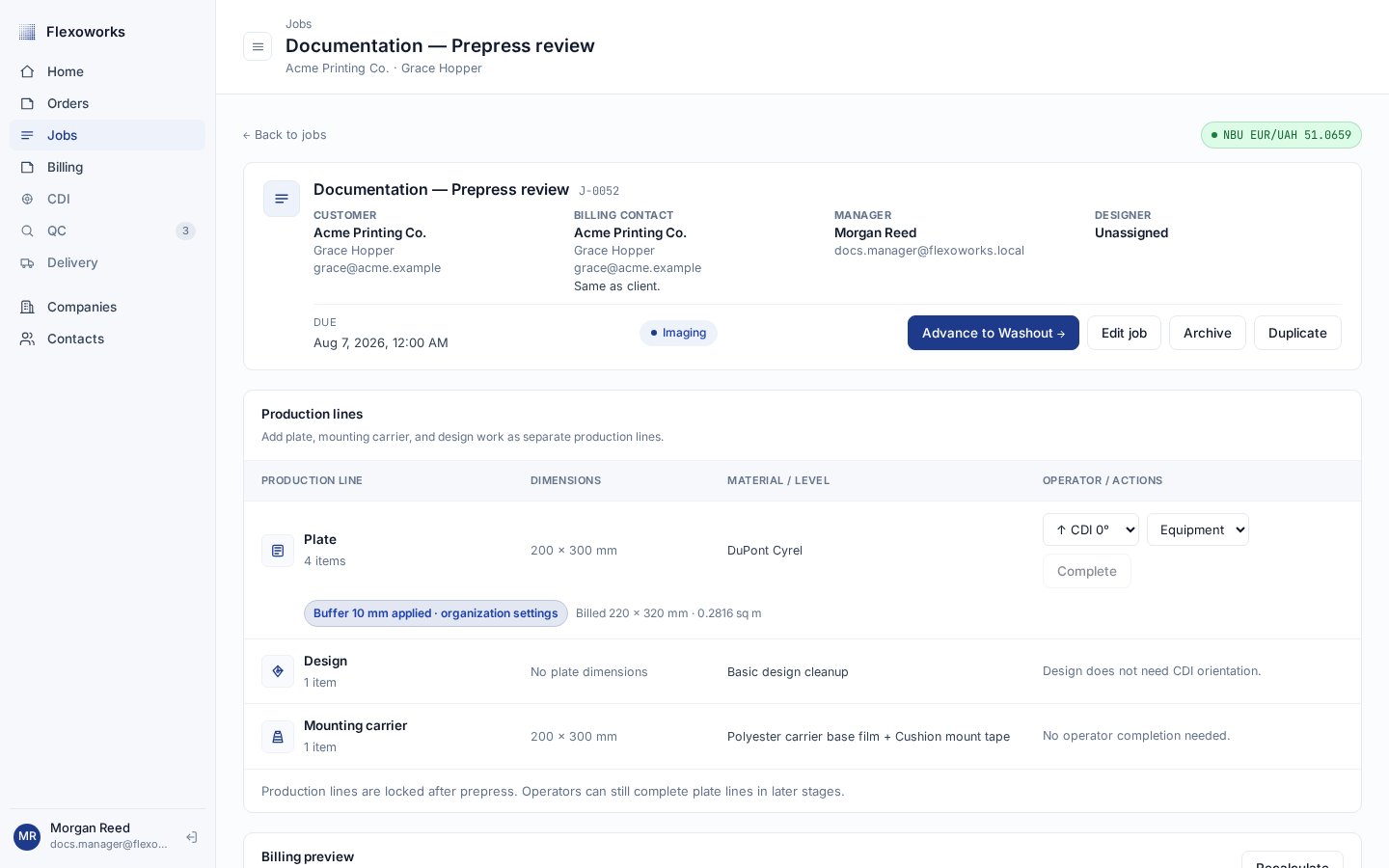 ## Complete Plate work without changing the job stage
In **Imaging**, an operator chooses the **CDI orientation** and **Equipment**
for a Plate line and selects **Complete**. Flexoworks records the entire line's
Quantity together with the operator, orientation, equipment, and completion
time.
There is no partial-quantity completion. Mounting carrier and Design lines do
not have operator-completion controls.
Completing a Plate line does **not** advance the job. The job stays in
**Imaging** until someone uses the separate **Advance to Washout** stage
action. Production-line completion and [job stage
transitions](/guides/job-stages-and-transitions) answer different questions:
“Is this batch complete?” and “Where is the whole job now?”
For the dedicated operator workflow, including whole-line confirmation and
undo rules, see [Use the production-floor terminal](/guides/floor-terminal-overview).
## Keep production lines and billing lines distinct
The job deliberately shows two separate sections:
| **Production lines** | **Billing preview** |
| -------------------------------------------------------------------------------------------- | ------------------------------------------------------------------------------------------------------------------------------------------------------ |
| Describes the work: kind, Quantity, size, materials or Design level, Buffer, and completion. | Shows frozen billing rows generated from the current work, rate card, prices for the effective **Billing company**, service rates, and manual changes. |
| Groups or splits items according to real production differences. | Can contain more than one priced row for one production line. |
| Locks after Prepress. | Keeps stored monetary rows so the current total is explicit and reviewable. |
A Plate line normally generates a material-area row. A Mounting carrier can
generate one row for **Base film** and another for **Cushion mount**. A Design
line generates a row from its **Design level**. Configured service rates can
add further rows.
“Frozen” means the billing rows are stored rather than being an invisible live
formula. Line changes during Intake or Prepress regenerate the relevant rows;
**Recalculate** refreshes them from the current pricing configuration. If the
work specification is correct but the commercial amount needs an exception,
use a billing-row override instead of falsifying the production line.
## Complete Plate work without changing the job stage
In **Imaging**, an operator chooses the **CDI orientation** and **Equipment**
for a Plate line and selects **Complete**. Flexoworks records the entire line's
Quantity together with the operator, orientation, equipment, and completion
time.
There is no partial-quantity completion. Mounting carrier and Design lines do
not have operator-completion controls.
Completing a Plate line does **not** advance the job. The job stays in
**Imaging** until someone uses the separate **Advance to Washout** stage
action. Production-line completion and [job stage
transitions](/guides/job-stages-and-transitions) answer different questions:
“Is this batch complete?” and “Where is the whole job now?”
For the dedicated operator workflow, including whole-line confirmation and
undo rules, see [Use the production-floor terminal](/guides/floor-terminal-overview).
## Keep production lines and billing lines distinct
The job deliberately shows two separate sections:
| **Production lines** | **Billing preview** |
| -------------------------------------------------------------------------------------------- | ------------------------------------------------------------------------------------------------------------------------------------------------------ |
| Describes the work: kind, Quantity, size, materials or Design level, Buffer, and completion. | Shows frozen billing rows generated from the current work, rate card, prices for the effective **Billing company**, service rates, and manual changes. |
| Groups or splits items according to real production differences. | Can contain more than one priced row for one production line. |
| Locks after Prepress. | Keeps stored monetary rows so the current total is explicit and reviewable. |
A Plate line normally generates a material-area row. A Mounting carrier can
generate one row for **Base film** and another for **Cushion mount**. A Design
line generates a row from its **Design level**. Configured service rates can
add further rows.
“Frozen” means the billing rows are stored rather than being an invisible live
formula. Line changes during Intake or Prepress regenerate the relevant rows;
**Recalculate** refreshes them from the current pricing configuration. If the
work specification is correct but the commercial amount needs an exception,
use a billing-row override instead of falsifying the production line.
 ## Check the lines before handoff
Before marking Prepress ready for review, confirm that:
* **Quantity** groups only identical work;
* work that will be completed separately is split into separate Plate lines;
* every physical line has the correct **Width**, **Height**, and materials;
* every Design line has the correct **Design level**;
* each Plate uses the intended effective **Buffer**;
* **Billing preview** reflects the work the customer should be charged for.
Then continue through [Prepress review](/guides/prepress-review) and the normal
[job stages and transitions](/guides/job-stages-and-transitions).
See how converting an incoming order creates production jobs.
Follow the job from Intake through Shipped.
Submit the checked production snapshot for manager approval.
Complete whole Plate lines from the CDI queue.
Track the physical material required by Plate production lines.
## Check the lines before handoff
Before marking Prepress ready for review, confirm that:
* **Quantity** groups only identical work;
* work that will be completed separately is split into separate Plate lines;
* every physical line has the correct **Width**, **Height**, and materials;
* every Design line has the correct **Design level**;
* each Plate uses the intended effective **Buffer**;
* **Billing preview** reflects the work the customer should be charged for.
Then continue through [Prepress review](/guides/prepress-review) and the normal
[job stages and transitions](/guides/job-stages-and-transitions).
See how converting an incoming order creates production jobs.
Follow the job from Intake through Shipped.
Submit the checked production snapshot for manager approval.
Complete whole Plate lines from the CDI queue.
Track the physical material required by Plate production lines.