

Send to queue records your manual handoff. Flexoworks does not currently
transfer files to DFS, create a master LEN, or submit to an Esko device.
Individual plates and gangs
A production line describes the required work and quantity. After manager approval of Prepress, Flexoworks creates one tracked plate for each required unit. Each plate has its own LEN file or separation identity and production status. A quantity of four therefore creates four individual plates. A plate gang is the arrangement on one physical inventory sheet. Compatible plates from different jobs or customers can share a gang. Plates from the same production line can use different gangs, orientations, equipment, and completion times without splitting the production line.Terminology
In English, layout or arrangement describes the positions and rotations
within a plate gang. Ukrainian розкладка also names this arrangement,
as in Запропонувати розкладку and Розкладка на листі. The phrase
розміщення форм describes the placement of the individual plates.
Open the ready queue
Open CDI from the full application’s sidebar. The upper list shows gangs; the lower list shows individual plates awaiting placement. Search by job, customer, or LEN file. Use the gang status filter to inspect active work or completed history. Load additional pages when needed: suggestions use the queue currently loaded in the editor.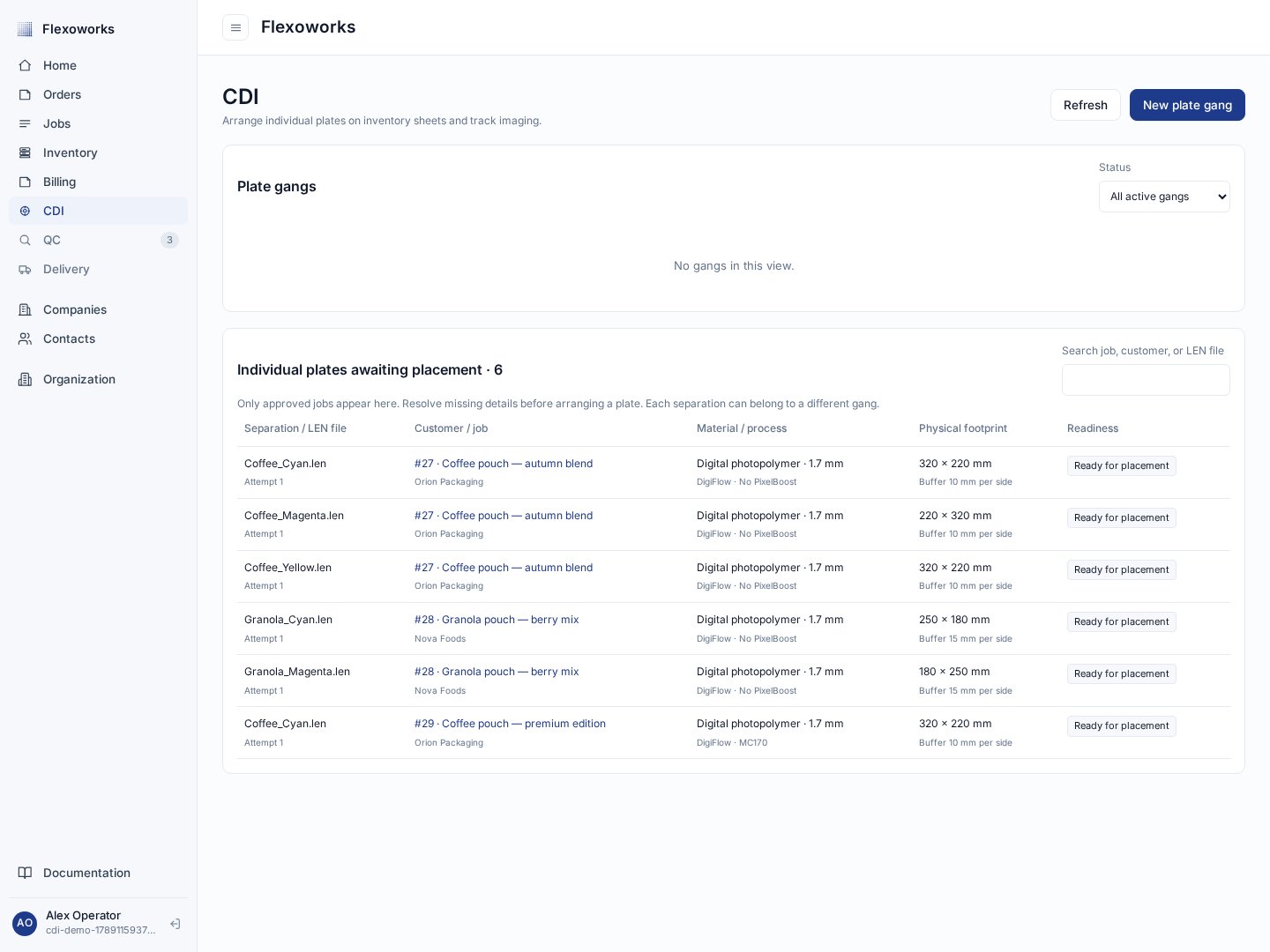
The ready queue lists each separation, its customer, process, and physical footprint.
Create a gang from inventory
- Select New plate gang.
- Choose an actual Physical sheet already available in inventory.
- Select Reserve sheet and create gang.
Suggest and adjust an arrangement
The editor shows compatible plates on the left and the proportional sheet on the right. A gang requires an exact match of:- material;
- thickness;
- technology;
- PixelBoost code, with no PixelBoost treated as a distinct setting; and
- production location.
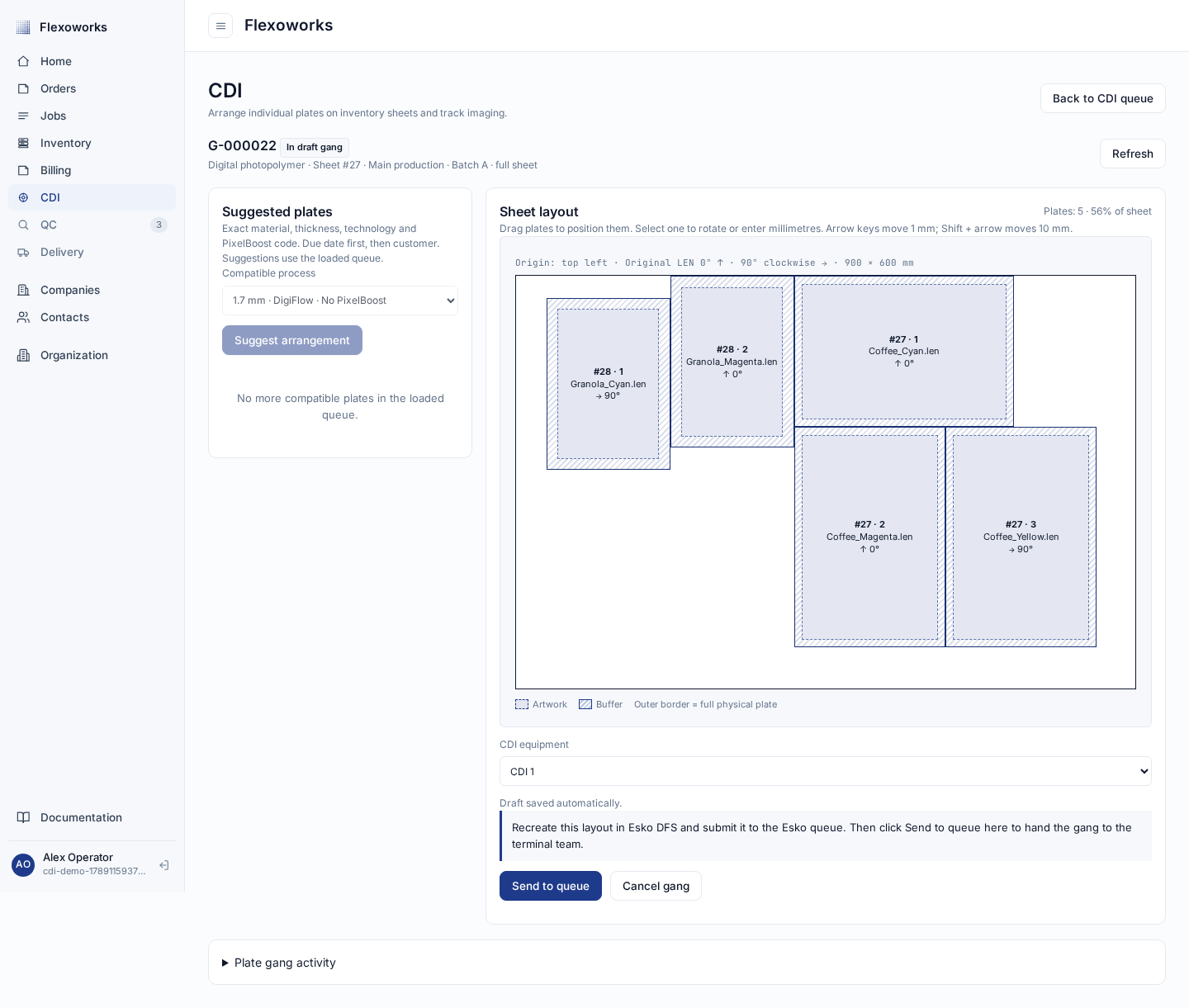
The suggested layout combines compatible work while showing artwork and customer buffer separately.
- drag a plate from the left list onto the sheet, or select Add;
- drag a placed plate to another position;
- select a plate and enter Left (mm) and Top (mm) coordinates;
- use arrow keys to move 1 mm, or Shift + arrow to move 10 mm;
- select Rotate clockwise to switch between 0° and 90° clockwise; or
- select Remove to return a draft placement to the available candidates.
Read artwork and buffer correctly
The inner area is Artwork. The hatched border is Buffer. The outer border is the full Physical footprint that must fit on the sheet. For 300 × 200 mm artwork with a 10 mm buffer on each side, the footprint is 320 × 220 mm. With a 15 mm buffer, it is 330 × 230 mm. Rotation swaps the full footprint’s axes. The buffer is applied once, not added again when placing. Each plate keeps the effective line, customer/payer, or organization buffer captured at release. Different customers’ plates can therefore have different buffers on the same sheet. See Production lines.Save automatically and send to queue
Draft positions, orientations, and CDI equipment save automatically after a short pause. Wait for Draft saved automatically. before leaving the page. If saving fails, the editor keeps the local layout, shows the error, and offers Retry. Queue submission remains disabled until that error is resolved. Retry first resolves the earlier save, then saves any newer local edits. If another operator has changed the saved layout, review it with Refresh before continuing; retry does not overwrite their changes. Choose the equipment at the sheet’s location. When the arrangement is ready:- Recreate the same positions and orientations in Esko DFS.
- Submit the arrangement to the Esko queue from DFS.
- Select Send to queue in Flexoworks.
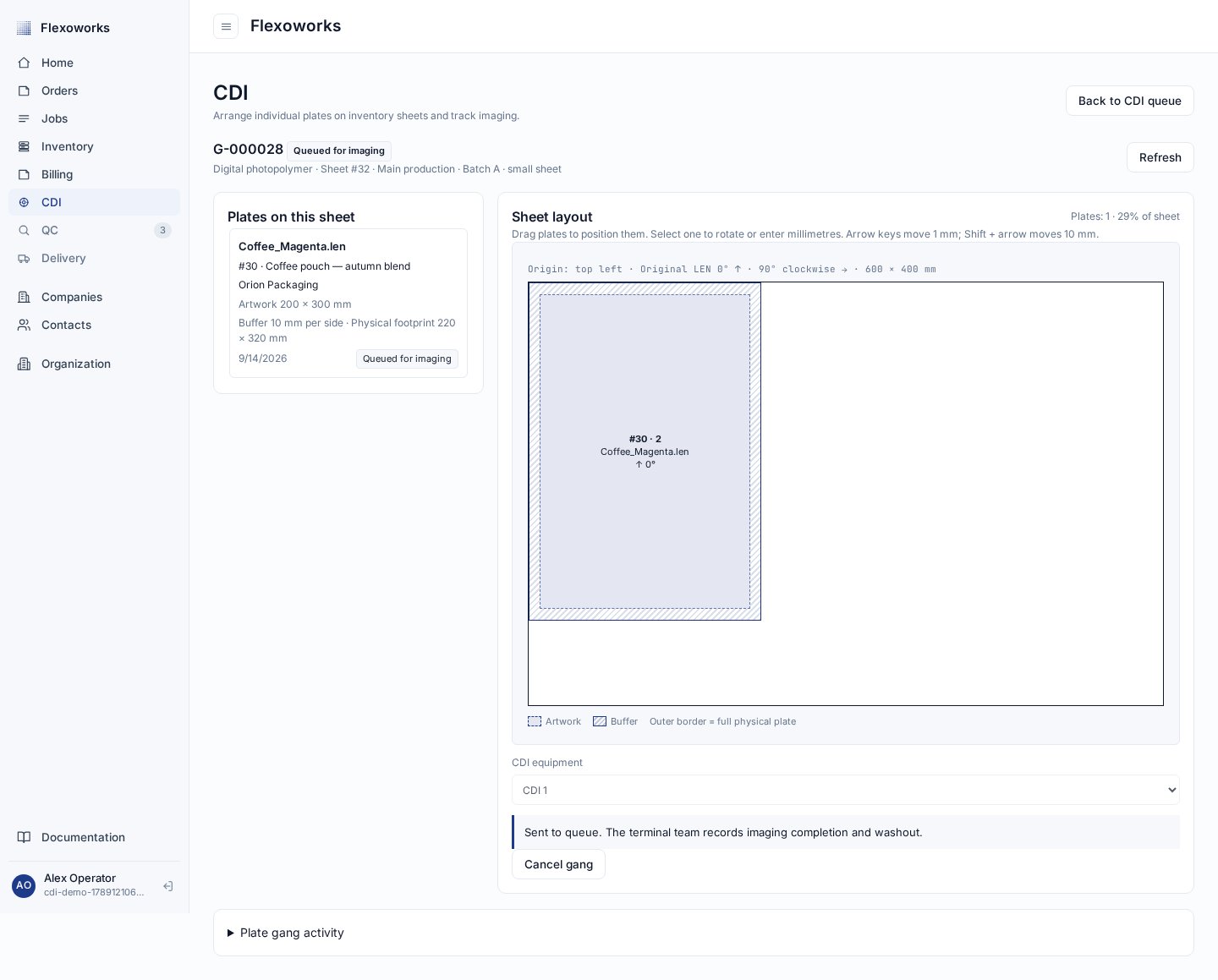
After the handoff, the saved layout remains visible and the terminal team owns the next production steps.
Cancel a draft or queued gang
Select Cancel gang, enter a Cancellation comment (required), then select Cancel gang in the form. A blank or whitespace-only comment cannot be submitted. Comments can contain up to 1,000 characters. For queued work, first remove the gang from the Esko queue and make sure imaging has not started. Flexoworks does not cancel work in Esko. Cancellation is unavailable once the terminal has recorded Finish imaging. Cancelling releases the reserved sheet and returns the plates to the ready queue. The gang leaves the active CDI and terminal queues, while its saved arrangement and the operator’s comment remain in Plate gang activity. Use the Cancelled status filter to find it later. To arrange those plates again, create a new gang using an available sheet.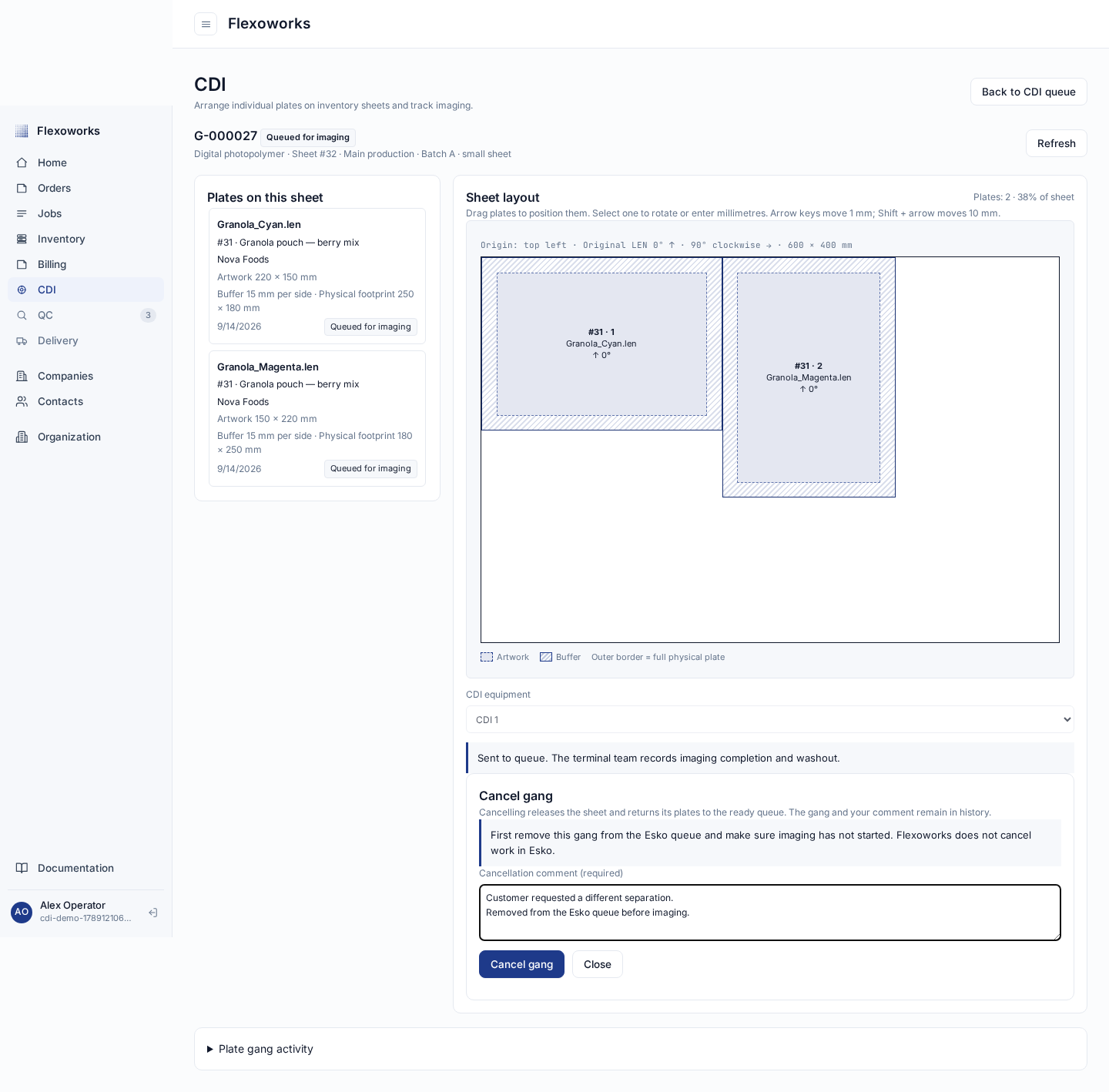
A queued gang can be cancelled only after entering a comment. Remove it from Esko first.
Follow progress and individual replacements
Older records can also show Imaging or a legacy completion. Their original
history is retained.
Open a job’s Individual plates card to see every separation, attempt,
physical footprint, status, gang link, and orientation. A job remains in Imaging
while any required current plate is not imaged. It moves to Washout when all are
imaged, then to QC when all are washed. Different gangs can progress independently.
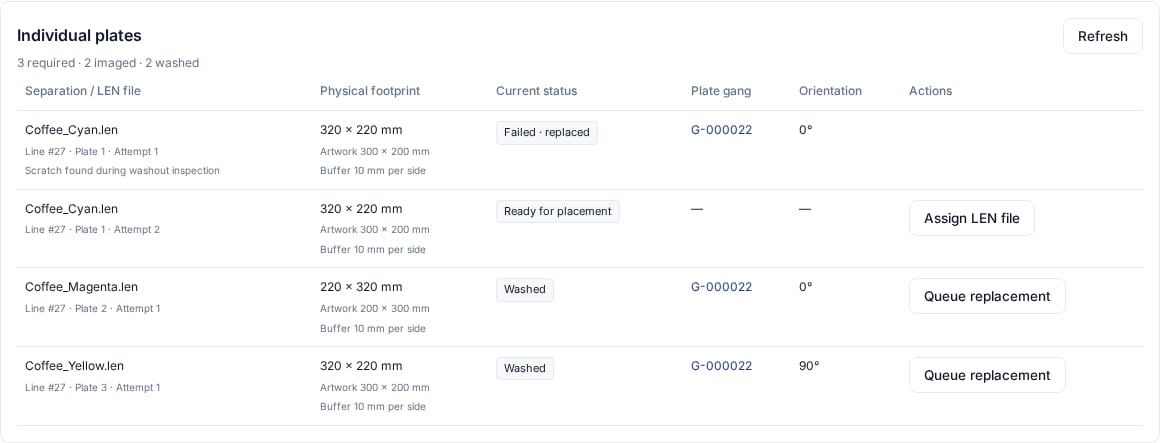
Replacing one failed separation preserves successful siblings, the original gang, and the required quantity.